


Parents refused right to name son Allah
Friday, December 25, 2009
In the latest battle over what people may legally call their children, the Swedish Tax Authority (Skatteverket) has ruled that the parents of a two-month-old boy in Skåne in southern Sweden may not call their child Allah.
According to the decision, Skatteverket does not approve “names that can give offence or be seen to cause discomfort for the bearer”. In this case, Skatteverket was “of the opinion that the name can be seen as objectionable for religious reasons.”
Skatteverket legal expert Lars Tegenfeldt told The Local that devout members of the public might take offense to certain names with highly religious connotations.
“God or Allah or the Devil is offensive to the public. Not me personally, but there are religious people who think so,” he said.
“Some religious names though, like Jesus, are normal,” he added.
There have been several high profile cases in Sweden over the authority's seemingly arbitrary decisions regarding first names it deems acceptable.
In 2007, for example, a couple was initially banned from calling their daughter Metallica (a decision later overturned), while authorities in another part of Sweden allowed a baby boy to be called Google. Other controversial names rejected by the agency have included Q, Token and Michael Jackson.
The parents told The Local they do not plan to appeal the Skatteverket's decision rejecting the name Allah.
The Local, 23 December 2009
Demonstrators protest against CAIR street cleaning
Friday, December 25, 2009
A small group of demonstrators led by Americans Against Hate Chairman Joe Kaufman last Friday accused Broward County and the Town of Davie of supporting an organization with ties to Islamic terrorists.
A street sign in Davie sparked the anger of the demonstrators who protested in front of the Broward County Governmental Center in Fort Lauderdale on a rainy Friday afternoon.
The sign, at the southwest corner of College Avenue and Nova Drive, credits the Miami office of the Council on American Islamic Relations ( CAIR-FL) for its participation in a Broward County program to clear litter from an "adopted" street.
Kaufman said when he complained about the sign, a spokesman for the Town of Davie told him it would not be removed because CAIR had a Constitutional right to free speech.
"Freedom of speech is a poor excuse," Kaufman said to the demonstrators. "This is not about free speech. It's about terrorism."
The United States Department of Justice has linked Washington, DC-based CAIR to Hamas, which the U.S. government considers a terrorist organization. CAIR was named an unindicted co-conspirator during the federal trial in Dallas of the Holy Land Foundation, the largest Islamic charity in the United States.
"We're here to question Broward County's long-time affiliation with CAIR," Jeff Rubinoff, a Davie resident, said. Rubinoff accused the county of "complicity in supporting a terrorist organization."
He mentioned a CAIR fundraiser at the Fort Lauderdale Convention Center, the Broward County School Board naming CAIR-Florida representative Jawhar "Joe" Badran to a diversity committee and CAIR's Broward County bus ads that he said denigrated Jews and Christians.
"Broward County is once again finding themselves on the wrong side," Rubinoff said. "So far their ears remain closed and they turn their backs to us."
Calls to Broward County Mayor Ken Keechl and Davie Mayor Judy Paul on Friday, before the Jewish Journal went to press, were not returned.
"Too many people have been quiet about their concerns over Muslim extremism," said Rabbi Andrew Jacobs of Ramat Shalom synagogue in Plantation. Stopping it must begin locally, in Broward County, he said. It's time for people to raise their voices about the threat posed by CAIR, Jacobs added.
Muhammad Malik, executive director of CAIR-Florida's Miami office, said the organization wanted to bring out people to pick up litter from the street, like any other group.
Malik said he met with Davie officials and with administrators in the county's Adopt-A-Street program. Neither had a problem with CAIR's sign, he said.
Kaufman and Americans Against Hate "emotionalize" by having a rally on Hanukkah, Malik said. He said he didn't think the Town of Davie would be influenced by the demonstration.
Malik accused Israel of terrorism in the war with Hamas in Gaza. "There were some bad things happening on both sides," he said. "If we really were with Hamas, then I wouldn't be describing acts by Hamas."
Sun Sentinel, 22 December 2009
Discrimination suit filed on behalf of African-American Muslim worker
Friday, December 25, 2009
CAIR-Chicago announced today that it has filed a complaint in federal court against USF Holland and YRC Worldwide Inc. on behalf of an African-American Muslim former employee. The complaint alleges that the man, Reginal Exson, suffered discrimination based on his race, religion and disability.
Exson worked as a truck driver for USF Holland out of the company’s Cook County location. Mr. Exson claims that a company representative made derogatory remarks regarding his race, such as “You are a black f***ing liar. I never met a black person that didn’t lie. It must be part of your gene pool.”
After sustaining extensive injuries on the job in an accident for which he was not at fault in November 2007, Mr. Exson says that the company refused to honor his doctor-recommended work restrictions and subjected him to discipline based on false allegations.
In addition to this discriminatory treatment, a worker’s compensation coordinator is alleged to have called Mr. Exson a “terrorist,” saying, “Did you think I was going to let you and Osama bin Laden get off with all this money that we’re paying you?” Another representative refused to recognize Mr. Exson’s right to pray pursuant to his religious beliefs, allegedly stating “I don’t give a damn about your religion or your prayers.”
Mr. Exson also says that his benefits provider, YRC Worldwide Inc. (the parent company of USF Holland), refused to properly compensate him for work-related injuries or accommodate his restrictions so that he could return back to work. Mr. Exson has not received any pay or benefits from the companies since March 2009.
“Employers must act to ensure that employees work in environments free from racism and anti-Islamic sentiments,” said Kevin Vodak, Staff Attorney at CAIR-Chicago. “Based on Mr. Exson’s allegations, the large trucking corporations involved in this lawsuit fostered blatantly discriminatory terms and conditions that no employee should have to endure.”
CAIR, 21 December 2009
Students Report on Islam in Unique Course
Friday, December 25, 2009
AST LANSING, Mich., Dec. 11 (UPI) — A new course at Michigan State University teaches students how to deal with the complexities of reporting on Islam in a post-Sept. 11 world.
This semester, students wrote about holiday celebrations and about how Muslim students feel about American university life. They also analyzed news reports on Islam from around the world in the new, “Reporting on Islam” course at Michigan State University.
“[The course] definitely made me uncomfortable at times, but honestly, that is how I know it was worthwhile,” said Dan Redford, a student. “It helped me experience a part of the world and this country that I never had before.”
Students uploaded the stories they wrote and the photos they took to UPIU.com, a service of United Press International for university students. Professor Geri Alumit Zeldes said that she wanted the class to submit its stories to UPIU to “have an outlet, other than me, to share their stories.”
Of the 14 registered students in the course, half had at least one of their stories published online through UPIU. Student Andrew Norman’s story on Islamic punk music was featured in blog in The San Francisco Sentinel and Wall Street Journal.
Student Brian J. Bowe said that using Web tools such as Skype to talk to people in other countries helped “shrink the world,” an exciting aspect of the course.
“Those classroom interactions with people in places like Iraq, Iran and India enriched the experience for me,” Bowe said. “One of the problems in media portrayals of Islam is that we’re frequently talking about Muslims, but not to Muslims. Using technology, we were able to bridge cultures and have very profound dialogues.”
Students also talked to Muslims who live in Michigan as sources for some articles.
“I found our visit to [the Islamic Center of East Lansing] highly beneficial. I would have been timid about going there alone,” said student Jennifer Hoewe. “Since I was joined by my classmates and welcomed by those who attended the mosque, I felt comfortable enough to go again by myself later in the semester as part of an article I wrote.”
The new class comes as students across the United States are showing more interest in Islam and in academic topics affiliated with the faith. Three of the students in “Reporting on Islam” studied Arabic, two of them through the university’s Arabic department, which had roughly 150 students enrolled in classes this fall.
Several of the students in “Reporting on Islam” also are in the Muslim Studies specialization program, which was created by Professor Mohammed Ayoob after the Sept. 11, 2001, attacks. The reporting course was just one of many offered this semester under this specialization, along with classes in arts and humanities, public affairs, religion, political science, anthropology and sociology.
“Reporting on Islam” is a good first step for many students to continue learning about the topic, said Zahkia Smith, a student.
“I think what’s most important coming out of this class is that the very best way to know how to report on Islam is to get involved and actually step into the Muslim community,” Smith said. “The class gives you the right tools. The completion of the class is the signal to dig further.”
“Reporting on Islam” is a pilot course offered jointly through Michigan State’s School of Journalism and its Muslim Studies program. It was started with a grant from the Social Science Research Council, a national non-profit group. In addition, the course is part of the Islam, Muslims, and Journalism Education program, a project on the Internet funded by the same grant that has a goal to generate accurate and balanced reporting.
Similar courses have been taught at other American university campuses, Zeldes said. For example, Marda Dunsky, instructor of Islamic World Studies at DePaul University, teaches the “Reporting the Arab and Muslim World” course.
UPIU.com, 24 December 2009
Muslim police chef defeated in 'bacon roll' tribunal
Friday, December 25, 2009
A Muslim chef who lost a claim of religious discrimination against Scotland Yard after complaining he was forced to cook sausages and bacon faces a legal bill of more than £75,000.
Hasanali Khoja accused the Metropolitan Police of failing to consider his Islamic beliefs when he was asked to handle pork products as a catering manager at a police station.
The £23,000-a-year chef claimed suggestions by his bosses that he should wear gloves and use tongs left him 'stressed and humiliated'. Muslims are banned from eating pork under Islamic law.
But Mr Khoja, 62, lost his claim in May after a police employee told an employment tribunal how she saw Mr Khoja eat bacon rolls and sausages.
The Metropolitan Police Authority (MPA) has now won a ruling ordering Mr Khoja to pay its costs, which total at least £76,200. In its costs claim, the Met said Mr Khoja 'knew that he had asked for a bacon roll two or three times for personal consumption before bringing his claim and throughout the conduct of his claim'.
'The fact that he had knowingly come into contact with pork products before bringing the claim shows that the claim had no reasonable prospect of success from the outset.'
Judge Michael Southam agreed and ruled Mr Khoja should pay costs, though these would be determined at a later date at a county court.
Mr Khoja, from Edgware, North London, who is still employed by the Met, claimed at a hearing in Watford that he could afford to pay only £80 a week as he has little income, lives in rented property and is struggling with £30,000 legal bills of his own.
But the court discovered he had sold another home last year, splitting profits of almost £200,000 with his wife and two sons.
The decision is another setback for the police chef, who believed he was on course for a large settlement when he launched his case in 2007.
Mr Khoja, who sits on a Foods Standards Agency advisory committee on Muslim issues, decided to take action after Scotland Yard chiefs placed him on unpaid leave for a year after his refusal to work with pork.
He said he was then given work in a different building but his role was downgraded.
But his case fell apart when another caterer, Mary Boakye, told the court she served him bacon rolls 'two or three' times at the Met canteen at Heathrow in West London.
When she told him she was surprised because his religion banned him from eating pork, Mr Khoja allegedly replied: 'I eat them once in a while.'
Another chef said he saw Mr Khoja once happily eat a sausage dish and told the court 'he was not as strict as some Muslims'.
Judge Southam also heard how Mr Khoja had made 'wild and baseless' allegations about a human resource manager, allegedly making racial facial gestures.
Mr Khoja is one of several ethnic minority staff to launch racial discrimination claims against Scotland Yard. The most high-profile was former Assistant Commissioner Tarique Ghaffur, who last year accused Sir Ian Blair of excluding him from the upper echelons of the force because of his skin colour.
Mr Ghaffur retired after receiving an out-of-court settlement and dropped the allegations.
Daily Mail UK, 20 December 2009
US group uses Times Square to promote Islam
Friday, December 25, 2009 An American Muslim advocacy group launched a massive advertisement in New York City's infamous Times Square on Tuesday in a bid to present to millions of Americans a "fair" and "accurate" portrayal of Islam.
The public service announcement, "I am Muslim, I am American," was launched by the New York branch of the Council on American-Islamic Relations (CAIR) and aims to show people that Muslims are a valuable part of American society.
The advertisement starts with the statement "Building Community, Serving Country" and features American Muslims from all walks of life, including a police sergeant, a Little League all-star, a human rights activist, a doctoral candidate and an attorney.
"This public service advertisement features ordinary American Muslims whose everyday lives are dedicated to building community and serving country," Faiza Ali, CAIR New York's Community Affairs Director, said.
 Ali added that "this initiative is part of our ongoing effort to ensure that a fair and accurate portrayal of Islam and Muslims is presented to the American public.”
The campaign will run from Dec. 22 to Jan. 16, and will even be shown on New Year's Eve, when at least one million people are expected to crowd Times Square for celebrations and the infamous countdown, when the ball drops at midnight.
"We have more than 400 million people going through Times Square and we thought this would be a good opportunity to send out a positive message about Muslims," Ibrahim Cooper, CAIR's national communications director, told Al Arabiya.
And the message is simple "that American Muslims are a vital part of our society and people have an opportunity to learn more about them," Hooper said.
And for those who have never been to Times Square, Hooper explained that the advertisement will appear on the CBS Super Screen, which is a 26-foot by 20-foot full-motion screen, called a "JumboTron," and will air 18 times a day.
"We hope that the millions of people from around the nation and the world who view this public service announcement will return home with enhanced understanding of Islam and the American Muslim community," CAIR's National Executive Director, Nihad Awad, said.
And according to Hooper although the advertisement has only been up for a day it has already been well received.
"The reaction has been very positive and we have already had people showing an interest and donating online."
CAIR, 23 December 2009

Muslims join Jews for Christmas Day Mitzvah
Thursday, December 24, 2009
DETROIT – Many Jews consider Christmas Day an opportunity to serve their community while Christian neighbors celebrate their holiday. This year, what's also known as Mitzvah Day in southeast Michigan is getting an added boost from Muslims.
For the first time, about 40 Muslims are expected to join 900 Jews for what they call their largest annual day of volunteering. Leaders say it's a small but significant step in defusing tensions and promoting good will between the religions — particularly on a day that is sacred to Christianity, the third Abrahamic faith.
Mitzvah Day, a nearly 20-year tradition in the Detroit area also practiced in other communities, is so named because Mitzvah means "commandment" in Hebrew and is generally translated as a good deed.
The new partnership stemmed from a recent meeting between members of the Council of Islamic Organizations of Michigan, the Jewish Community Relations Council and the Jewish Federation of Metropolitan Detroit — which said it was unaware of any similar Mitzvah Day alliances.
The Jewish groups organize Mitzvah Day, which consists of volunteers helping 48 local social service agencies with tasks such as feeding the hungry and delivering toys to children in need.
Victor Begg, chairman of the Islamic council, said he was seeking a public way for the two faith communities to "build bridges of understanding and cooperation," which led to joining the Mitzvah Day effort.
"The general public is what we need to give the message to, our entire community," he said.
Not only are most Muslims and Jews available to serve on Christmas Day, but leaders also recognized a shared commitment to community service. Charity in Judaism is known as "tzedakah." In Islam, it's called "zakat."
"It's an interesting parallel," said Robert Cohen, executive director of the Jewish Community Relations Council. "Both of our faiths predispose us to engaging in this sort of thing."
Muslim and Jewish volunteers will work together at the Gleaners Community Food Bank in Pontiac, about 25 miles north of Detroit.
"We felt it was a perfect activity for people to be getting together like this because you work side by side with one or two other people as you're moving the boxes," Cohen said. "The grass-roots connection builds relationships on a personal level."
Cohen said the local bonds are important given global animosities. He said Muslims and Jews here "have serious differences about what happens in the Middle East," but that shouldn't be the only dynamic defining their relationship.
Begg added the two faiths can set an example in the Detroit area, which has historically large Jewish and Muslim populations.
"Whatever happens in the Middle East, we have no control over it," Begg said. "But here, our kids go to the same school, we work together. ... We need to focus on building an inclusive community."
Mitzvah Day is planned months in advance, so the number of Muslim participants is modest to start, but both groups expect it will grow. Next year proves challenging for Jewish volunteers because Christmas falls on a Saturday, the Jewish Sabbath.
Details have yet to be worked out, though Cohen and others are considering moving Mitzvah Day. That would give Muslims the opportunity to try a solo run on Christmas, join Jewish groups on another day, or both.
"The bottom line is we really want to do it together," Begg said.
AP, 24 December 2009
Britons Side with Banning Minarets in UK
Thursday, December 24, 2009
People in Britain are open to the idea of banning minarets, according to a three-country poll by Angus Reid Public Opinion. 37 per cent of respondents in Britain would vote in favour of a ban, while 25 per cent would vote against it.
In the United States, 21 per cent of respondents would vote to ban minarets, while 19 per cent disagree. In Canada, 35 per cent of respondents would vote against a ban, while 27 per cent would endorse one.
Within the frame of Switzerland’s direct-democracy system, a group of citizens or leaders of the eight cantons together can call a referendum to challenge a law approved by the federal legislature. The vote is decided with a simple majority.
Last year, the ultra-nationalist Swiss People’s Party (SVP) gathered more than 113,000 signatures to force a nationwide referendum on banning the construction of minarets in Swiss mosques. The minaret—a tower from which the call to prayer is sounded—is a distinctive architectural feature of Islamic mosques. At this time, only the mosques in Geneva, Wangen near Olten, Winterthur and Zurich have minarets.
Last month, 57.5 per cent of Swiss voters cast a ballot in favour of banning the construction of minarets in Swiss mosques.
Taner Hatipoglu, president of the Federation of Islamic Organisations in Zurich, expressed dismay at the outcome of the referendum, saying, "The initiators have achieved something everyone wanted to prevent, and that is to influence and change the relations to Muslims and their social integration in a negative way."
Polling Data
Suppose a similar referendum took place in [COUNTRY]. Would you vote in favour or against banning minarets in [COUNTRY]?
Source: Angus Reid Strategies
Methodology: Online interviews with 1,000 Canadian adults, 1,004 American adults, and 2,002 British adults, conducted from Dec. 9 to Dec. 12, 2009. Margins of error range from 2.2 per cent to 3.1 per cent.
Angus Reid Global Monitor, 22 December 2009
In the United States, 21 per cent of respondents would vote to ban minarets, while 19 per cent disagree. In Canada, 35 per cent of respondents would vote against a ban, while 27 per cent would endorse one.
Within the frame of Switzerland’s direct-democracy system, a group of citizens or leaders of the eight cantons together can call a referendum to challenge a law approved by the federal legislature. The vote is decided with a simple majority.
Last year, the ultra-nationalist Swiss People’s Party (SVP) gathered more than 113,000 signatures to force a nationwide referendum on banning the construction of minarets in Swiss mosques. The minaret—a tower from which the call to prayer is sounded—is a distinctive architectural feature of Islamic mosques. At this time, only the mosques in Geneva, Wangen near Olten, Winterthur and Zurich have minarets.
Last month, 57.5 per cent of Swiss voters cast a ballot in favour of banning the construction of minarets in Swiss mosques.
Taner Hatipoglu, president of the Federation of Islamic Organisations in Zurich, expressed dismay at the outcome of the referendum, saying, "The initiators have achieved something everyone wanted to prevent, and that is to influence and change the relations to Muslims and their social integration in a negative way."
Polling Data
Suppose a similar referendum took place in [COUNTRY]. Would you vote in favour or against banning minarets in [COUNTRY]?
| CAN | USA | BRI | |
| In favour | 27% | 21% | 37% |
| Against | 35% | 19% | 25% |
| Would not vote | 16% | 29% | 18% |
| Not sure | 22% | 32% | 21% |
Methodology: Online interviews with 1,000 Canadian adults, 1,004 American adults, and 2,002 British adults, conducted from Dec. 9 to Dec. 12, 2009. Margins of error range from 2.2 per cent to 3.1 per cent.
Angus Reid Global Monitor, 22 December 2009
Germans Anxious About Growth of Islam
Saturday, December 19, 2009
(Angus Reid Global Monitor) - Most people in Germany express a certain degree of anxiety over the growth of the Islamic religion and culture in the country, according to a poll by Infratest-Dimap released by ARD. 33 per cent of respondents are very concerned about this matter, and 29 per cent express moderate concern.
Germany is home to Europe’s second-largest Muslim community after France.
Last month, voters in Switzerland participated in a referendum which banned the construction of minarets in Swiss mosques. The minaret—a tower from which the call to prayer is sounded—is a distinctive architectural feature of Islamic mosques.
On Dec. 13, Thilo Sarrazin, a former Berlin finance senator and current member of the German Central Bank committee, said Muslim headscarves should be banned in Germany.
Earlier this year, Sarrazin was criticized after he declared: "A large number of Arabs and Turks in this city, whose number has grown through bad policies, have no productive function other than as fruit and vegetable vendors."
Polling Data
Are you concerned about the growth of Islam in Germany?
Source: Infratest-Dimap / ARD
Methodology: Telephone interviews with 1,000 German adults, conducted in December 2009. Margin of error is 3.1 per cent.
Angus Reid Global Monitor, 19 December 2009
Germany is home to Europe’s second-largest Muslim community after France.
Last month, voters in Switzerland participated in a referendum which banned the construction of minarets in Swiss mosques. The minaret—a tower from which the call to prayer is sounded—is a distinctive architectural feature of Islamic mosques.
On Dec. 13, Thilo Sarrazin, a former Berlin finance senator and current member of the German Central Bank committee, said Muslim headscarves should be banned in Germany.
Earlier this year, Sarrazin was criticized after he declared: "A large number of Arabs and Turks in this city, whose number has grown through bad policies, have no productive function other than as fruit and vegetable vendors."
Polling Data
Are you concerned about the growth of Islam in Germany?
| Yes, very concerned | 33% |
| Yes, moderately concerned | 29% |
| No, not concerned | 22% |
Methodology: Telephone interviews with 1,000 German adults, conducted in December 2009. Margin of error is 3.1 per cent.
Angus Reid Global Monitor, 19 December 2009
Swiss minaret ban reaches European Court of Human Rights
Friday, December 18, 2009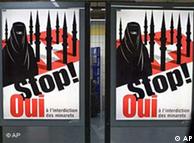
Algerian-born Hafid Ouardidi lodged the complaint with the human rights court in Strausbourg, saying the referendum violates the right to religious freedom. Ouardidi is a former spokesman at the Geneva Mosque.
The referendum passed in Switzerland after 57.5 percent of the country's citizens approved the measure in a November 29 vote. The Swiss national government urged its citizens to vote against the measure, which was supported by a campaign from the right-wing Swiss People's Party. The party opposed the "Islamisation of Switzerland."
One of Ouardidi's lawyers, Pierre de Preux, said that the Swiss government and all members of the European Council had been informed of the complaint.
"We will have both the plaintiff Hafid Ouardiri and the defendant, [the Swiss government], saying the same thing," de Preux told Reuters news agency. "The court is still free to decide whatever it wants, but it sure is going to help the request."
The European Court of Human Rights must still decide if it will accept Ouardidi's complaint.
mz/AP/Reuters, 16 December 2009
The Hypocrisy of al-Demoqratia
Friday, December 18, 2009
In 2004, France banned headscarves and school principals chased after young "defiant" Muslim girls who continued to cover their heads in school. Now, following a national referendum, Switzerland has banned the construction of minarets, because minarets also somehow symbolize oppression. Thanks to the dedicated action of the far-right Swiss People's Party, the Alpine skies will be free from the snaking menace, which would spread intolerance and taint the splendor of Swiss architecture.
In between these two peculiar events, the targeting of Muslims in Western countries and the subjugation of entire Muslim nations all over the world has never ceased. Not for a day.
Moreover, the collective targeting of small or large Muslim communities in Western countries, and the deliberate abuse and degradation of Muslim individuals and Islamic symbols (from the Holy Qur'an to the Prophet Mohammed) has also never ceased.
Bizarrely, most of these actions have been done through "democratic" channels and justified in the name of democracy, on the basis of upholding the principles of secularism and Western values.
Many thoughts come to mind here; all unreservedly angry.
I remember when the word "democracy" used to resonate so loudly among Arabs and Muslims around the world. The more they were denied it, the more they yearned for it. University campuses in Cairo, Gaza and Karachi took their student union elections so very seriously. Innocent blood was spilled in clashes around campuses as students desperately tried to express their right to vote, to speak out and to assemble.
Those were the days, when al-demoqratia, Arabic for democracy, was the buzzword in the Middle East and beyond. Even Palestinian political prisoners held their elections, ever so faithfully, surrounded by highly fortified towers and under the deriding gaze of armed men in the unforgiving heat of the Naqab desert.
Arab and Muslim masses were keen on democracy to the extent that there was a near consensus that democracy, although a Western conception, could be distinguished from the many ills invited by Western interventions, imperialism and wars that scarred and continued to impair the collective Muslim psyche.
An entire school of Muslim thought was in fact established around the concept that democracy and Islam are very much compatible. Such a notion goes back to Egypt's Azharite scholar Rifa'a al-Tahtawi, who argued in the first half of the 19th century that the principles of European modernity were compatible with Islam.
"Al-Tahtawi's work influenced the philosopher Muhammad Abduh [1849-1905], another Azharite who is often described as the founder of Islamic modernism, which is captured in his statement that in Europe he found Islam without Muslims, while in Egypt he found Muslims without Islam," wrote German anthropologist, Frank Fanselow.
If one sets his prejudices aside to ponder this for a moment, one would realize the intellectual valor it takes to consider and even embrace commonalities with the very powers that have instilled so much harm and fear.
Even in their darkest, least proud moments, Muslim intellectuals and nations displayed impressive open-mindedness. They are hardly ever credited for that.
More recently, in Egypt, people tried hard to vote, in the face of beatings, public humiliation and imprisonment. In Palestine in 2006 the price was even higher — starvation. Gaza continues to endure under a medieval Israeli siege, ultimately because of an election.
Muslim communities in the West have long been considered the luckiest; after all, they live in the abodes of democracy. They drink from the fountain of rights and freedoms that never runs dry.
However, these idealized assumptions missed the fact that Western democracy was conditional. And unconditional democracy can only be a farce.
Much has been said to explain the West's faltering on its own commitment to democracy. No, the tragedy of September 11, 2001, is hardly the defining moment that created the growing chasm that made the West fearful of Islam. Despite all that has taken place since then — the constant spewing out of right-wing hatred, fanatic evangelical preaching and all the rest — America is still more tolerant than Europe. Nor was the growing anti-Muslim sentiment in Europe a response in solidarity to America's woes.
Honestly, the French are not fond of Americans, nor are the Germans necessarily that passionate about the Swiss. But this didn't stop a German Christian Democratic state interior minister, Volker Bouffier, from making a "recommendation" to Muslim communities in his own country: "Naturally the Muslims in Germany have a right to build mosques. But they should make sure not to overwhelm the German population with them."
How do you overwhelm people with minarets? Is this a post-post-post-modernistic logic that we are yet to be informed of?
There are only four minarets in the entire country of Switzerland, a country with a population of approximately 7.6 million people. How overwhelming can that be? And aren't religious freedom and the freedom of collective and individual expression basic rights guaranteed by democratic values?
But this is hardly about a 4.8-meter tall minaret in the northern Swiss town of Langenthal. It's about the fact that the one who suggested the structure is a Muslim furniture salesman by the name of Mutalip Karaademi. He didn't know, of course, that his modest idea of adding a minaret to the community's mosque would generate a nationwide referendum, and an international "controversy."
Karaademi was not trying to "Islamificate" the Swiss. He just wanted his community to have a place for worship (as opposed to the unused paint factory it currently uses for prayer), to be able to express its collective identity without fear. Ironically enough, the Muslim community in Langenthal is mostly Albanians, refugees who fled Kosovo seeking escape and deliverance.
What a strange paradox: Muslims escaping to the West, physically and figuratively, only to find double standards, self-negation and, at times, pure hypocrisy.
For now, however, a new consensus is forming: democracy can be invoked and used against Muslims only, and not for Muslims. It can be manipulated to deny them their identity in Europe and their freedom in Palestine, to ensure their subjugation in Iraq and in Afghanistan, and to meddle in their internal affairs everywhere else.
Al-demoqratia, indeed.
Ramzy Baroud (www.ramzybaroud.net) is an author and editor of PalestineChronicle.com. His work has been published in many newspapers, journals and anthologies around the world. His latest book is "The Second Palestinian Intifada: A Chronicle of a People's Struggle," (Pluto Press, London), and his forthcoming book is "My Father Was a Freedom Fighter: Gaza's Untold Story." (Pluto Press, London), now available for pre-orders on Amazon.com.
Arab American News, 11 December 2009
The allegedly growing domestic Muslim threat
Friday, December 18, 2009
There is clearly a concerted effort by the Government to claim loudly that the threat posed by radicalized American Muslims is increasing. Last week, The Los Angeles Times published a lengthy, scary story under the headline "U.S. sees homegrown Muslim extremism as rising threat," claiming that "Anti-terrorism officials and experts see signs of accelerated radicalization among American Muslims." Homeland Security Secretary Janet Napolitano warned this month: "Home-based terrorism is here." When justifying his Afghanistan escalation at West Point, Obama warned of "extremists within our borders who were sent here from the border region of Afghanistan and Pakistan to commit new acts of terror." And strangely, on Saturday, two articles with virtually identical storylines appeared -- one in The Washington Post and the other in The New York Times -- warning that American Muslims, for the first time, are now becoming a radicalized threat in the way European Muslims are.
At least from all appearances, these claims are being made exclusively on the basis of a handful of recent episodes involving American Muslims accused of having links to Al Qaeda and/or the Taliban. There is no data whatsoever offered to corroborate the claim of a "trend." Given the obvious dangers inherent in trumpeting threats from internal sources -- as well as the motives the Government generally has in disseminating such warnings and the motive it specifically has when escalating a war -- far more than a few anecdotes ought to be required before any of this is believed.
What's most striking about these "warnings" is that they virtually never examine the reasons why this would be happening. Why, after all this time, would American Muslims suddenly be more willing to engage in violence against the U.S.? To his credit, Scott Shane devoted several paragraphs of his NYT article to addressing this question, and what he finds is both highly significant and highly unsurprising:
By Glenn Greenwald
Salon, 14 December 2009
At least from all appearances, these claims are being made exclusively on the basis of a handful of recent episodes involving American Muslims accused of having links to Al Qaeda and/or the Taliban. There is no data whatsoever offered to corroborate the claim of a "trend." Given the obvious dangers inherent in trumpeting threats from internal sources -- as well as the motives the Government generally has in disseminating such warnings and the motive it specifically has when escalating a war -- far more than a few anecdotes ought to be required before any of this is believed.
What's most striking about these "warnings" is that they virtually never examine the reasons why this would be happening. Why, after all this time, would American Muslims suddenly be more willing to engage in violence against the U.S.? To his credit, Scott Shane devoted several paragraphs of his NYT article to addressing this question, and what he finds is both highly significant and highly unsurprising:
[T]he continuing wars in Iraq and Afghanistan, and the American operations like drone strikes in Pakistan, are fueling radicalization at home, [terrorism expert Robert Leiken] said. "Just the length of U.S. involvement in these countries is provoking more Muslim Americans to react," Mr. Leiken said . . . .
Like many other specialists, [Georgetown University terrorism expert Bruce] Hoffman pointed to the United States' combat in Muslim lands as the only obvious spur to many of the recent cases, especially those with a Pakistani connection. "The longer we’ve been in Iraq and Afghanistan," he said, "the more some susceptible young men are coming to believe that it’s their duty to take up arms to defend their fellow Muslims."
A few analysts, in fact, argue that Mr. Obama’s decision to send more troops to Afghanistan -- intended to prevent a terrorist haven there -- could backfire.
Robert A. Pape, a University of Chicago political scientist, contends that suicide attacks are almost always prompted by resentment of foreign troops, and that escalation in Afghanistan will fuel more plots. "This new deployment increases the risk of the next 9/11,” he said. “It will not make this country safer."The evidence proving this causation is now so overwhelming as to be undeniable. Waging wars, occupying, and dropping bombs in Muslim countries is the single most counter-productive step that can be taken to combat Islamic extremism (indefinitely imprisoning them without charges is a close second). It's akin to advising a lung cancer patient to triple the quantity of cigarettes he smokes each day. Yet we continue to do it over and over, and then point to the harms we cause as reasons we need to continue doing it. Our "counter-terrorism" campaign basically consists of three steps repeated endlessly:
(1) Interfere in or otherwise act aggressively in the Muslim world.The coordinated campaign to hype the alleged "growing domestic Muslim threat" at exactly the time we are escalating our conventional war in Afghanistan and our covert Predator war in Pakistan is a perfect illustration of this process. Basically, what Shane's article reveals is the shocking truth that waging war and otherwise interfering in Muslim countries for more a full decade radicalizes Muslims and drives some of them to want to return the violence. Who would have guessed?
(2) Provoke increased anti-American sentiment and fuel terrorism as a result of Step 1.
(3) Point to the increased anti-American sentiment and terrorism as a reason we need to escalate our interference and aggression in the Muslim world. Return to Step 1.
By Glenn Greenwald
Salon, 14 December 2009


Subscribe to:
Posts (Atom)