


Showing posts with label Mosque. Show all posts
Showing posts with label Mosque. Show all posts
Mosque burned to the ground by arsonists
Tuesday, December 29, 2009 CRADLEY Heath’s Muslim community is appealing for help after its mosque was burnt to the ground by arsonists.
A fire engulfed the Cradley Heath Mosque and Islamic Centre in Plant Street on Boxing Day destroying the building and the religious countless books inside.
It is the second time in five years that the building has been targeted by arsonists and police are hunting the culprits.
The West Midlands Fire Service first reported that the blaze on Plant Street had destroyed 'industrial units' in Plant Street but when the smoke cleared it became obvious the building was a mosque.
The mosque was a thriving part of the community with 400 worshippers using it and classes of children being taught there.
The worshippers are now trying to find a new place to worship as the new Mosque they have being building alongside the old one will not be ready for use for several years.
Basharat Ali, secretary of the mosque and education centre, said: “This is not the first time we have been targeted, there was a similar attack four or five years ago.
“The building has been completely destroyed and all the books we use with the children have been damaged by water.”
“He added: “The new building is under construction, it is a shell inside and it is due to open in a few years.”
Halesowen News, 29 December 2009
Detroit bomber linked to London Mosque
Tuesday, December 29, 2009
MI5 believe that the suspect could have developed links with other extremists during three years he spent in Britain studying at University College London. They will investigate where he worshipped and whether he was radicialised in the UK or elsewhere.
The East London Mosque secretary, Ayub Khan, said that it was "appalled" by Abdulmutallab's alleged attempts to blow up a plane on its way to Detroit. But it could not confirm or deny suggestions that Abdulmutallab visited the mosque.
Earlier this year, the venue was criticised for hosting a pre-recorded talk by Anwar al-Awlaki, a radical cleric based in Yemen, who the US Department for Homeland Security said acted as a spiritual leader for three of the 9/11 hijackers.
At the time, the mosque said that it did not organise the event, and the group running it had hired out their facilities.
In a statement released yesterday Mr Khan, the secretary, said: "It goes without saying that the East London Mosque condemns in the strongest possible terms the alleged attempt to blow up a transatlantic airliner in the USA.
"The mosque has consistently spoken out against such acts, and will continue to do so.
"It is not the policy of the mosque to invite speakers who are at variance with this policy, and we try to ensure that those who hire out our facilities adhere to this principle.
"Given its community service to people of all faiths, the East London Mosque is appalled that it should be associated with such heinous acts.
"Over 20,000 people, of Muslim and other faiths, visit the mosque every week.
"They use the mosque for many different purposes including worship, weddings, and to use any of the 30 different projects and services that are based at our institution."
He added: "The mosque is open for the public to use on a daily basis. We have no membership like a church and therefore cannot comment on whether this individual came to East London Mosque.
"Our institution is a place where people are inspired to do good works for all people, of all faiths and none. We therefore are appalled by the alleged actions of this individual."
Telegraph UK, 29 December 2009
Britons Side with Banning Minarets in UK
Thursday, December 24, 2009
People in Britain are open to the idea of banning minarets, according to a three-country poll by Angus Reid Public Opinion. 37 per cent of respondents in Britain would vote in favour of a ban, while 25 per cent would vote against it.
In the United States, 21 per cent of respondents would vote to ban minarets, while 19 per cent disagree. In Canada, 35 per cent of respondents would vote against a ban, while 27 per cent would endorse one.
Within the frame of Switzerland’s direct-democracy system, a group of citizens or leaders of the eight cantons together can call a referendum to challenge a law approved by the federal legislature. The vote is decided with a simple majority.
Last year, the ultra-nationalist Swiss People’s Party (SVP) gathered more than 113,000 signatures to force a nationwide referendum on banning the construction of minarets in Swiss mosques. The minaret—a tower from which the call to prayer is sounded—is a distinctive architectural feature of Islamic mosques. At this time, only the mosques in Geneva, Wangen near Olten, Winterthur and Zurich have minarets.
Last month, 57.5 per cent of Swiss voters cast a ballot in favour of banning the construction of minarets in Swiss mosques.
Taner Hatipoglu, president of the Federation of Islamic Organisations in Zurich, expressed dismay at the outcome of the referendum, saying, "The initiators have achieved something everyone wanted to prevent, and that is to influence and change the relations to Muslims and their social integration in a negative way."
Polling Data
Suppose a similar referendum took place in [COUNTRY]. Would you vote in favour or against banning minarets in [COUNTRY]?
Source: Angus Reid Strategies
Methodology: Online interviews with 1,000 Canadian adults, 1,004 American adults, and 2,002 British adults, conducted from Dec. 9 to Dec. 12, 2009. Margins of error range from 2.2 per cent to 3.1 per cent.
Angus Reid Global Monitor, 22 December 2009
In the United States, 21 per cent of respondents would vote to ban minarets, while 19 per cent disagree. In Canada, 35 per cent of respondents would vote against a ban, while 27 per cent would endorse one.
Within the frame of Switzerland’s direct-democracy system, a group of citizens or leaders of the eight cantons together can call a referendum to challenge a law approved by the federal legislature. The vote is decided with a simple majority.
Last year, the ultra-nationalist Swiss People’s Party (SVP) gathered more than 113,000 signatures to force a nationwide referendum on banning the construction of minarets in Swiss mosques. The minaret—a tower from which the call to prayer is sounded—is a distinctive architectural feature of Islamic mosques. At this time, only the mosques in Geneva, Wangen near Olten, Winterthur and Zurich have minarets.
Last month, 57.5 per cent of Swiss voters cast a ballot in favour of banning the construction of minarets in Swiss mosques.
Taner Hatipoglu, president of the Federation of Islamic Organisations in Zurich, expressed dismay at the outcome of the referendum, saying, "The initiators have achieved something everyone wanted to prevent, and that is to influence and change the relations to Muslims and their social integration in a negative way."
Polling Data
Suppose a similar referendum took place in [COUNTRY]. Would you vote in favour or against banning minarets in [COUNTRY]?
| CAN | USA | BRI | |
| In favour | 27% | 21% | 37% |
| Against | 35% | 19% | 25% |
| Would not vote | 16% | 29% | 18% |
| Not sure | 22% | 32% | 21% |
Methodology: Online interviews with 1,000 Canadian adults, 1,004 American adults, and 2,002 British adults, conducted from Dec. 9 to Dec. 12, 2009. Margins of error range from 2.2 per cent to 3.1 per cent.
Angus Reid Global Monitor, 22 December 2009
Swiss minaret ban reaches European Court of Human Rights
Friday, December 18, 2009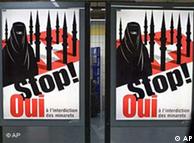
Algerian-born Hafid Ouardidi lodged the complaint with the human rights court in Strausbourg, saying the referendum violates the right to religious freedom. Ouardidi is a former spokesman at the Geneva Mosque.
The referendum passed in Switzerland after 57.5 percent of the country's citizens approved the measure in a November 29 vote. The Swiss national government urged its citizens to vote against the measure, which was supported by a campaign from the right-wing Swiss People's Party. The party opposed the "Islamisation of Switzerland."
One of Ouardidi's lawyers, Pierre de Preux, said that the Swiss government and all members of the European Council had been informed of the complaint.
"We will have both the plaintiff Hafid Ouardiri and the defendant, [the Swiss government], saying the same thing," de Preux told Reuters news agency. "The court is still free to decide whatever it wants, but it sure is going to help the request."
The European Court of Human Rights must still decide if it will accept Ouardidi's complaint.
mz/AP/Reuters, 16 December 2009
The Hypocrisy of al-Demoqratia
Friday, December 18, 2009
In 2004, France banned headscarves and school principals chased after young "defiant" Muslim girls who continued to cover their heads in school. Now, following a national referendum, Switzerland has banned the construction of minarets, because minarets also somehow symbolize oppression. Thanks to the dedicated action of the far-right Swiss People's Party, the Alpine skies will be free from the snaking menace, which would spread intolerance and taint the splendor of Swiss architecture.
In between these two peculiar events, the targeting of Muslims in Western countries and the subjugation of entire Muslim nations all over the world has never ceased. Not for a day.
Moreover, the collective targeting of small or large Muslim communities in Western countries, and the deliberate abuse and degradation of Muslim individuals and Islamic symbols (from the Holy Qur'an to the Prophet Mohammed) has also never ceased.
Bizarrely, most of these actions have been done through "democratic" channels and justified in the name of democracy, on the basis of upholding the principles of secularism and Western values.
Many thoughts come to mind here; all unreservedly angry.
I remember when the word "democracy" used to resonate so loudly among Arabs and Muslims around the world. The more they were denied it, the more they yearned for it. University campuses in Cairo, Gaza and Karachi took their student union elections so very seriously. Innocent blood was spilled in clashes around campuses as students desperately tried to express their right to vote, to speak out and to assemble.
Those were the days, when al-demoqratia, Arabic for democracy, was the buzzword in the Middle East and beyond. Even Palestinian political prisoners held their elections, ever so faithfully, surrounded by highly fortified towers and under the deriding gaze of armed men in the unforgiving heat of the Naqab desert.
Arab and Muslim masses were keen on democracy to the extent that there was a near consensus that democracy, although a Western conception, could be distinguished from the many ills invited by Western interventions, imperialism and wars that scarred and continued to impair the collective Muslim psyche.
An entire school of Muslim thought was in fact established around the concept that democracy and Islam are very much compatible. Such a notion goes back to Egypt's Azharite scholar Rifa'a al-Tahtawi, who argued in the first half of the 19th century that the principles of European modernity were compatible with Islam.
"Al-Tahtawi's work influenced the philosopher Muhammad Abduh [1849-1905], another Azharite who is often described as the founder of Islamic modernism, which is captured in his statement that in Europe he found Islam without Muslims, while in Egypt he found Muslims without Islam," wrote German anthropologist, Frank Fanselow.
If one sets his prejudices aside to ponder this for a moment, one would realize the intellectual valor it takes to consider and even embrace commonalities with the very powers that have instilled so much harm and fear.
Even in their darkest, least proud moments, Muslim intellectuals and nations displayed impressive open-mindedness. They are hardly ever credited for that.
More recently, in Egypt, people tried hard to vote, in the face of beatings, public humiliation and imprisonment. In Palestine in 2006 the price was even higher — starvation. Gaza continues to endure under a medieval Israeli siege, ultimately because of an election.
Muslim communities in the West have long been considered the luckiest; after all, they live in the abodes of democracy. They drink from the fountain of rights and freedoms that never runs dry.
However, these idealized assumptions missed the fact that Western democracy was conditional. And unconditional democracy can only be a farce.
Much has been said to explain the West's faltering on its own commitment to democracy. No, the tragedy of September 11, 2001, is hardly the defining moment that created the growing chasm that made the West fearful of Islam. Despite all that has taken place since then — the constant spewing out of right-wing hatred, fanatic evangelical preaching and all the rest — America is still more tolerant than Europe. Nor was the growing anti-Muslim sentiment in Europe a response in solidarity to America's woes.
Honestly, the French are not fond of Americans, nor are the Germans necessarily that passionate about the Swiss. But this didn't stop a German Christian Democratic state interior minister, Volker Bouffier, from making a "recommendation" to Muslim communities in his own country: "Naturally the Muslims in Germany have a right to build mosques. But they should make sure not to overwhelm the German population with them."
How do you overwhelm people with minarets? Is this a post-post-post-modernistic logic that we are yet to be informed of?
There are only four minarets in the entire country of Switzerland, a country with a population of approximately 7.6 million people. How overwhelming can that be? And aren't religious freedom and the freedom of collective and individual expression basic rights guaranteed by democratic values?
But this is hardly about a 4.8-meter tall minaret in the northern Swiss town of Langenthal. It's about the fact that the one who suggested the structure is a Muslim furniture salesman by the name of Mutalip Karaademi. He didn't know, of course, that his modest idea of adding a minaret to the community's mosque would generate a nationwide referendum, and an international "controversy."
Karaademi was not trying to "Islamificate" the Swiss. He just wanted his community to have a place for worship (as opposed to the unused paint factory it currently uses for prayer), to be able to express its collective identity without fear. Ironically enough, the Muslim community in Langenthal is mostly Albanians, refugees who fled Kosovo seeking escape and deliverance.
What a strange paradox: Muslims escaping to the West, physically and figuratively, only to find double standards, self-negation and, at times, pure hypocrisy.
For now, however, a new consensus is forming: democracy can be invoked and used against Muslims only, and not for Muslims. It can be manipulated to deny them their identity in Europe and their freedom in Palestine, to ensure their subjugation in Iraq and in Afghanistan, and to meddle in their internal affairs everywhere else.
Al-demoqratia, indeed.
Ramzy Baroud (www.ramzybaroud.net) is an author and editor of PalestineChronicle.com. His work has been published in many newspapers, journals and anthologies around the world. His latest book is "The Second Palestinian Intifada: A Chronicle of a People's Struggle," (Pluto Press, London), and his forthcoming book is "My Father Was a Freedom Fighter: Gaza's Untold Story." (Pluto Press, London), now available for pre-orders on Amazon.com.
Arab American News, 11 December 2009
Chimney pot minaret defies Swiss voters
Tuesday, December 15, 2009
Guillaume Morand extended a chimney, gave it the form of a minaret and sprayed it in gold paint to protest against a constitutional amendment approved in a nationwide referendum last month.
“It was scandalous that the Swiss voted for the ban,” said Mr Morand, 46, who owns the Pomp It Up chain of shoe stores.
“Now we [the Swiss] have the support of all the far-right parties across Europe. This is shameful.”
Anti-Muslim graffiti found on French mosque
Tuesday, December 15, 2009
CASTRES, France – Police say assailants have scrawled a Nazi slogan and hung pig feet on a mosque in southern France.
Interior Minister Brice Hortefeux has denounced the "vile and racist desecration" of the mosque in the town of Castres.
Police say the swastika in black paint and slogans including Hitler salute "Sieg Heil" in German, "France to the French" in French, and "White Power" in English were scrawled on the mosque.
Interior Minister Brice Hortefeux has denounced the "vile and racist desecration" of the mosque in the town of Castres.
Police say the swastika in black paint and slogans including Hitler salute "Sieg Heil" in German, "France to the French" in French, and "White Power" in English were scrawled on the mosque.
Swiss Muslims protest minaret ban
Sunday, December 13, 2009
BERN, Switzerland – Around 700 Swiss Muslims peacefully protested against their country's minaret ban on Saturday, with speakers denouncing what they called a hate campaign against Islam.
The protest in the capital, Bern, was not supported by the country's main Muslim organizations.
It came two weeks after Swiss voters decided to ban the construction of minarets, drawing wide criticism from Muslim and other European nations.
The protest in the capital, Bern, was not supported by the country's main Muslim organizations.
It came two weeks after Swiss voters decided to ban the construction of minarets, drawing wide criticism from Muslim and other European nations.
Mosque: Families of detained men struggling
Saturday, December 12, 2009
ALEXANDRIA, Va. – A spokesman for a Virginia mosque says the families of five young Americans detained in Pakistan after they allegedly sought to join up with terrorist groups are going through "severe hardship."
During a news conference at the Islamic Circle of North America mosque, spokesman Essam Tellawi asked people to pray for the families. He says the small community mosque in Alexandria focuses on how families raise their children and the church promotes tolerance.
During a news conference at the Islamic Circle of North America mosque, spokesman Essam Tellawi asked people to pray for the families. He says the small community mosque in Alexandria focuses on how families raise their children and the church promotes tolerance.
Jewish community hits out at 'divisive' anti-Muslim protesters
Saturday, December 12, 2009
LEADING members of Harrow's Jewish community have joined together to condemn anti-Muslim campaigners who are planning a protest in the borough this weekend.
Rabbis Aaron Goldstein, Hillel Athias-Robles, Kathleen Middleton, Frank Dabba Smith, and Michael Hilton have signed a letter offering unequivocal support for the borough's Muslim community.
They wrote: “As leaders of the Jewish community in Harrow, we are writing to express our support for our Muslim friends and neighbours, especially those at Harrow Central Mosque, who are under attack from those whose only purpose is to spread hatred and fear.
Rabbis Aaron Goldstein, Hillel Athias-Robles, Kathleen Middleton, Frank Dabba Smith, and Michael Hilton have signed a letter offering unequivocal support for the borough's Muslim community.
They wrote: “As leaders of the Jewish community in Harrow, we are writing to express our support for our Muslim friends and neighbours, especially those at Harrow Central Mosque, who are under attack from those whose only purpose is to spread hatred and fear.
Fear still influences attitudes toward Muslims in Europe
Saturday, December 12, 2009
Since the Swiss voted in a November referendum to prohibit the building of new minarets in their country, the debate over Islam and Muslims and their place in Europe has been reopened. The discussion has confirmed suspicions that instead of moving toward peaceful coexistence, a basic mistrust and even rejection of Islam and its adherents are growing.
A pattern has begun to emerge in the reactions in several European countries to the minaret issue. In Germany, the Netherlands, Great Britain or France, the dismay of one commentator was usually countered by another who was seemingly sympathetic to the Swiss decision, and expressed the need "to understand the fears of the population," which felt itself being slowly dominated by Islam.
A pattern has begun to emerge in the reactions in several European countries to the minaret issue. In Germany, the Netherlands, Great Britain or France, the dismay of one commentator was usually countered by another who was seemingly sympathetic to the Swiss decision, and expressed the need "to understand the fears of the population," which felt itself being slowly dominated by Islam.
French President defends Switzerland minaret ban
Wednesday, December 09, 2009
Nicolas Sarkozy today voiced sympathy for Switzerland's controversial decision to ban the building of Muslim minarets, calling on religious practitioners to avoid "ostentation" and "provocation" for fear of upsetting others.
The French president said he was surprised by the widespread criticism of the outcome of last week's referendum in Switzerland when 57% voted to proscribe the building of new minarets in a country that has four, and is home to 400,000 Muslims.
Sarkozy's foreign minister, Bernard Kouchner, promptly denounced the Swiss decision last week, saying he was shocked and scandalised and calling for the ban to be reversed.
The French president said he was surprised by the widespread criticism of the outcome of last week's referendum in Switzerland when 57% voted to proscribe the building of new minarets in a country that has four, and is home to 400,000 Muslims.
Sarkozy's foreign minister, Bernard Kouchner, promptly denounced the Swiss decision last week, saying he was shocked and scandalised and calling for the ban to be reversed.
British Muslims urge British Government to declare 68 people persona non grata
Tuesday, December 08, 2009
London, (Council of Indian Muslims—UK):
British Indian Muslims have urged British Government to declare the 68
people persona non grata found guilty by the Justice Liberhan Commission for the demolition of 16th centaury Babri Mosque on 6 December 1992.
British Indian Muslims have urged British Government to declare the 68
people persona non grata found guilty by the Justice Liberhan Commission for the demolition of 16th centaury Babri Mosque on 6 December 1992.
Turkish-German director boycotts Switzerland in protest over minaret ban
Friday, December 04, 2009
Fatih Akin, one of Germany’s leading filmmakers, has decided he will not travel to Zurich for the Swiss premiere of his latest film, the award-winning Soul Kitchen.
Fatih Akin announced on Thursday that he will not attend the film's Swiss premiere as protest against the recent referendum banning the construction of minarets.In an open letter to the Swiss press, Akin said that the outcome of the referendum "conflicts with my understanding of humanism, tolerance and the belief that harmonious co-existence of peoples of differing backgrounds, races and religions must be possible."
Rabbi urges more tolerance for Muslims in Europe
Friday, December 04, 2009
PARIS (JTA) -- France’s chief rabbi said Europe must change its attitude about Islam.
Rabbi Gilles Bernheim said a Swiss vote Nov. 29 forbidding the construction of minarets alongside mosques was a clear sign that Western European leaders had “failed” at building tolerance toward Muslims, and he called on “all religions” as well as political leaders to increase interfaith dialogue.
“Today we need to act so that Europeans, and not just the Swiss, change their opinion about Islam,” he wrote in an editorial published Wednesday in the French daily Le Figaro.
Rabbi Gilles Bernheim said a Swiss vote Nov. 29 forbidding the construction of minarets alongside mosques was a clear sign that Western European leaders had “failed” at building tolerance toward Muslims, and he called on “all religions” as well as political leaders to increase interfaith dialogue.
“Today we need to act so that Europeans, and not just the Swiss, change their opinion about Islam,” he wrote in an editorial published Wednesday in the French daily Le Figaro.
Video: Jon Stewart commenting on and ridiculing Swiss decision to ban minarets
Friday, December 04, 2009Plans for Islamic center in Northville meets outcry
Saturday, November 28, 2009
Mohammad Usman wants Muslims in Novi and the Northville communities to have a convenient place to pray.
Many Muslims in the area travel to Canton or Farmington Hills if they want to attend daily prayers.
"We would like to have a place to worship like anyone else so we can fulfill our obligated prayers," Usman said.
But the location of the Meadowbrook Islamic Center, at 41885 Eight Mile in Northville Township, has some neighbors complaining. The center, which is not yet in use, is in a residential area and occupies a single-family home. Some neighbors also are opposed to the center's plans to create a parking lot on the front lawn.
Many Muslims in the area travel to Canton or Farmington Hills if they want to attend daily prayers.
"We would like to have a place to worship like anyone else so we can fulfill our obligated prayers," Usman said.
But the location of the Meadowbrook Islamic Center, at 41885 Eight Mile in Northville Township, has some neighbors complaining. The center, which is not yet in use, is in a residential area and occupies a single-family home. Some neighbors also are opposed to the center's plans to create a parking lot on the front lawn.


Subscribe to:
Posts (Atom)